What Time is it on the Clock of the World?

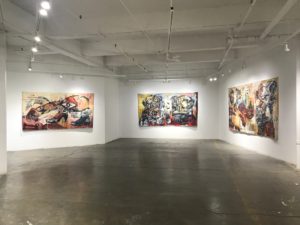
Reinhard Reitzenstein’s solo exhibition, WTF (Where’s the Forest), was on view at Buffalo Arts Studio from May 24-June 28, 2019. 

“What Time is it on the Clock of the World?”
Post-Exhibition Community Commentary by Harper Bishop

American revolutionary Grace Lee Boggs famously said, “What time is it on the clock of the world?”

This question is not merely a philosophical one, but one to be answered with action, which is why it has been adopted by so many within the ecological justice movement to address the global climate crisis and the solutions necessary to save the human species from extinction.

It is within that context that I received Reinhard Reitzenstein’s recent solo exhibit at Buffalo Arts Studio, WTF (Where’s the Forest). Whether consciously or subconsciously, Reitzenstein has taken Grace Lee Boggs’ question to heart. Reitzenstein’s keen observations and lengthy contemplations on the urgency for human beings to take notice of the web of life which sustains life, and life in abundance, in a technologically, development-driven age, particularly through his myriad studies of the tree in various mediums, have produced a body of work that serves as a reminder to us all that the time to reconnect to the natural world, to rediscover our own humanity, and to take bold action is not only nigh, it is now.
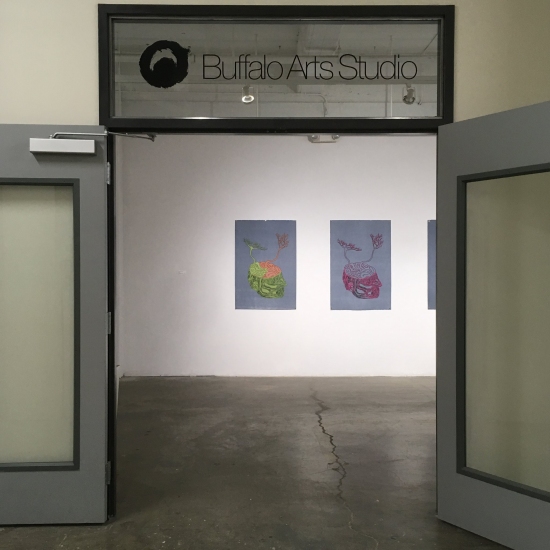
At the end of the long corridor on the 5th floor of the Tri-Main Building, the Buffalo Arts Studio entryway comes into view. Even before you reach the threshold of the front gallery, you see a set of three prints on oversized pieces of grey paper; a side profile of the same human being is situated in the middle of the paper. The brains and nervous systems have been replaced with tree roots, the top of which are coming out of the head, and offer a surrealist illustration of analogous systems. The bold colors become more muted with each iteration and one can’t help but feel both the fast and slow moving passage of time.
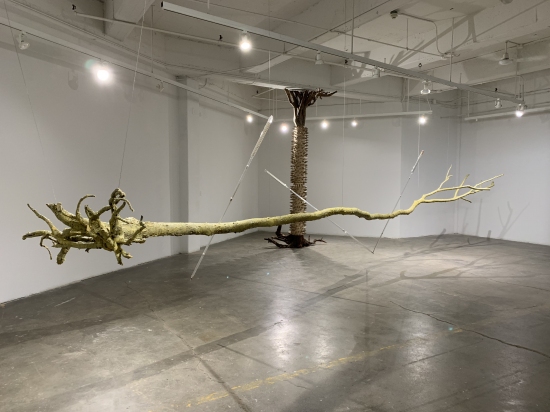
The most celebrated piece in the collection is a forty foot tree covered in yellow beeswax. “Feel the Buzz” is suspended from the ceiling of the second gallery and is the focal point of not only the space but of the show itself. Hidden in plain sight; it’s only after the viewer has interacted with various other pieces (a few of which I’ve already mentioned) in the front gallery that the proverbial elephant in the room can no longer be evaded, a fitting analogy to the current climate crisis. Conceptually, Reitzenstein’s piece “points to the complicity of the industrial past and gentrified present in the production of greenhouse gasses and eradication of green spaces necessary to counteract global warming.”

A sharp critique, Reitzenstein, rightfully, cites capital as the source of the current climate crisis and reminds us that there’s no “turning back the clock” on harm caused to our environment in the name of “progress.”

Two other pieces co-located with Reitzenstein’s tree are “Add a Little to a Little and There will Be a Big Heap” and “The 11th Thunder.” The first one conspicuously stands in the far back left-hand corner of the gallery. Another tree, the roots and crown support the plywood rings and laser cut tree symbols that are reminiscent of air fresheners that have hung in rearview mirrors for decades. This is yet another contrast in the collection between the world as it is and should be, and the world under human subjugation. The latter piece is a sprawling neon installation with a combination of letters that is seemingly random at first glance, but actually contains a very specific and personal meaning relating to the artists life. Juxtaposed with the suspended horizontal tree, it brings to mind the human need to leave an imprint and the glaring difference of what that looks like.

Through his work, Reitzenstein subtly conveys a number of social and ecological messages that relate to the contrast of extractive and exploitative activity with right relationship with the natural environment. It foregrounds particularly those on the front lines of climate catastrophe and what sacrificed in order to concentrate power and wealth for the few at a cost to the many.
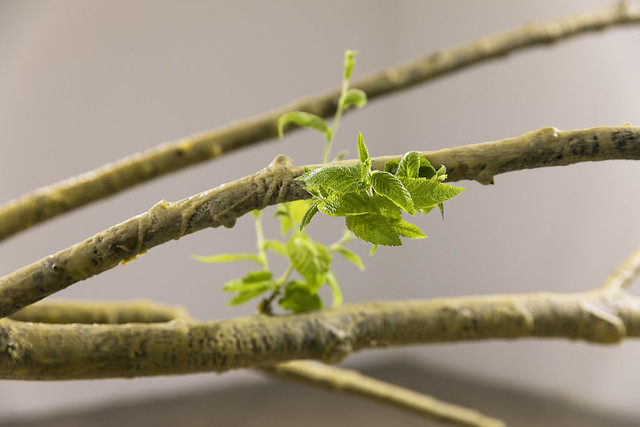
So, back to the clock. What time is it? According to the introspection of Reinhard Reitzenstein and the retrospection of WTF (Where’s the Forest), it feels like it’s close to the 11th hour. And yet, to bring this full circle, Grace Lee Boggs was known for her optimistic spirit and this exhibition channeled that spirit. A dead tree hanging from the ceiling of an art gallery is an unlikely candidate for new leaves, and yet it happened: they grew.

There’s still time. Be like the majestic trees forever enshrined in Reitzenstein’s work, with deep roots that allow them to stand with resolve and determination despite adverse conditions; roots that provide nourishment to continue the fight ahead; and, finally, roots that alert others in their network of a potential threat. For all of those interested in learning more about how to create sustainable and resilient communities learn more about PUSH Buffalo’s Green Development Zone, and for those who are ready to take bold action for climate justice now, contact PUSH Buffalo’s Climate Justice Organizer Geo Hernandez at geo@pushbuffalo.org or by visiting our website at www.pushbuffalo.org.

Harper Bishop is the Deputy Director of Movement Building at PUSH Buffalo, whose mission it is to mobilize residents to create strong neighborhoods with quality, affordable housing; to expand local hiring opportunities; and to advance economic and environmental justice in Buffalo, New York. He has nearly over a decade’s worth of experience in community-based organizations. Over that time, Bishop has helped to develop hundreds of grassroots leaders, written and advocated for progressive legislation, as well as organized campaigns to further the cause of economic, social, and racial justice in Western New York, most recently as the Director of Equitable Development at Open Buffalo.

Reinhard Reitzenstein’s WTF (Where’s the Forest) was the first exhibition in a two-year project that reflects the belief that artists and curators can effect change through purposeful collaborations that balance community need with artistic insight. Titled Justice in the Arts, this comprehensive project includes four exhibitions each year that foster critical dialogue about social, ecological, economic, and representational justice.

This project is supported in part by an award from the National Endowment for the Arts. To find out more about how National Endowment for the Arts grants impact individuals and communities, visit www.arts.gov.
Muhammad Zaman’s “LUX” at Buffalo Arts Studio

Muhammad Zaman’s LUX at Buffalo Arts Studio

Zainab Saleh

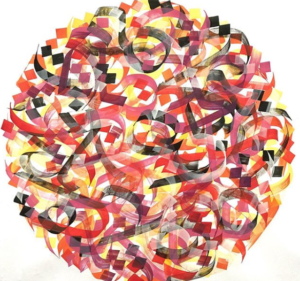
Muhammad Zaman, a resident artist at Buffalo Arts Studio, has quietly been filling his corner studio with all kinds of magical experiments over the past two years. Working on the walls, on paper, on canvases large and small, the tight space is a veritable enclave of color and energy. Zaman, who immigrated to the United States from Bangladesh at a young age, uses his art to explore questions of identity and language–especially as they relate to being a Muslim man in America. Using a style that fuses the principles of traditional Arabic calligraphy and a street art aesthetic, Zaman employs a mixture of English, Arabic, and Bengali, layering letters into harmonious, if illegible, compositions. Zaman is very clear about the purpose of his work, seeing it as a response to negative perceptions of Islam and of Muslims. For him, the multilingual nature of the work (and his person) offers up potential for dialog. His blending of multiple languages serves to reiterate that Muslims don’t all speak the same language, even if Arabic is the language of the Qur’an, and in the incomprehensibility of the characters, Zaman challenges his viewer to recognize and appreciate a potential lack of understanding. His first full-length exhibition, LUX, is an unassuming presentation of these themes and ideas that continue to permeate his process. 

Zaman borrows the word “calligraffiti” to describe his artistic mode, a term with uncertain origins, but one perhaps most notably employed right now by French Tunisian artist El Seed, who Zaman cites as an influence and mentor. It is also a term that, in its combination of calligraphy and graffiti, presents a sense of public space and public voice and divulges Zaman’s desire to be painting in the streets. Zaman’s work might be better placed in the category of hurufiyyah, a movement of Arab and Iranian art roughly dating to the 1940s, that abstracted the letter and positioned itself as a counterpoint to modern Western art. At the heart of this movement was a desire for freedom from actual and cultural colonizers, an expression of independence as well as individualism. Hurufiyyah was not a movement derivative of Islamic traditions of calligraphy, even if practitioners were often trained in those skills and found inspiration in the Arabic and Persian letter. Often, practitioners found themselves returning to the letter while living abroad: Hassan Massoudy in Paris, Madiha Omar in Washington, D.C. for instance. Zaman, and indeed El Seed as well, seem to be arguing for an expanded and contemporized, and perhaps culturally broadened, expression of this movement. 

Like El Seed, whose massive swirls of color and letter might be found on structures big and small all over the world, Zaman finds a word or phrase to encode into his paintings. As mesmerizing as the resulting composition is, the mystery of the secret message presents a facade unto itself. Nowhere is this more evident than in Find Your Tribe and Love them Hard. Its measured, even lines of white and black letters dancing atop a dark background project an impossible legibility, and the flecks of gold, purple and red paint weave in and out creating a harmonious tapestry that bleeds off the sides of the painting. Zaman’s is very introspective work, and herein lies the tension between Zaman’s desire for it to be more public and the interiority it exhibits.

I found the woven quality of Zaman’s work explored more literally in Our Colors Make Us Beautiful. The elegance of the letters and writing find themselves bounded by a frame internal to the canvas, comprised of thin lines perpendicular to the edge of the painting, alternating between black and white, silver and gold, creating the illusion of a tasselled fringe to a carpet–or, alternatively, in the case of Ignorance is the Cause of All Fears, where top and bottom are crimped in white paint, a prayer mat. While these paintings lack the sense of infinity evoked by some of his other work, it is here and in his “moon” pieces that I find Zaman actively exploring a question at the crux of this exhibition. 

Zaman actively desires to shine a positive light on his faith and fellow Muslims–and we might read that into his title LUX too–but at the heart of his work, Zaman seems to be investigating the tensions between cultural assimilation and identity. In his “moon” series, Zaman paints four phases of the moon, taking us through the lunar month with each stage, hitting upon a visual conception of seriality tied to the Islamic tradition, but also a temporality that illuminates the ebbs and flows of how words are read and how language accumulates meaning. Again, unlike his larger paintings where the letters continue, infinitely, off the edges of the canvas, these circular paintings seem more like snow globes, with the letters piled together in a jumble, pushing up against each other and the curved edge. These are interesting takes on shape poems, the chaos of letters illegible but recognizable as such. There is no gold here, exhibiting Zaman’s mastery of light, darkness, shadow, luminosity. I found Crescent particularly poignant, with the simplicity of the white background and black and grey letters gently ushering a new month, and the lone nuqta–a dot, serving as a diacritic mark–in the center like a star, connected by a silver thread to the rest of the letters. 

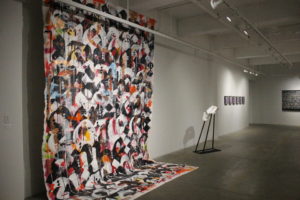
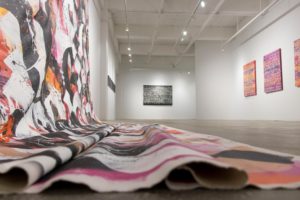
I wonder if here is where we might read the condition of the immigrant in exile, projected out from country, community, language. After all, the hurufiyah movement began at a remove from the countries its artists came from, an attempt to make sense of that distance. Zaman’s unique blend of the three languages so crucial to his identity also presents a question multilingual speakers might find familiar: which one to use, and when? In Aftermath, which greets each visitor to the gallery first, Zaman’s strokes are large, his colors bold, the letters almost legible. I make out a “G,” I think. And the Arabic letter “Ha.” As I walk towards the enormous canvas spilling onto the floor, I feel the muscles in my throat clenching with each letter I recognize, mentally sounding them out. In this larger canvas, we see not only Zaman’s aspirations for this work to be wrenched out of the gallery walls to meet a wider audience on the streets, but also a recognition of language that takes forms other than linguistic–child-size hand prints punctuate the background, their literal imprints providing a counterpoint to Zaman’s gestural trace. 

Zaman’s vision of his work extends outside the white walls of the gallery, and, indeed, walking towards the double glass doors of Buffalo Arts Studio with a large installation framed by the Buffalo Arts Studio entryway, it doesn’t take much to imagine his work adorning a wall or two flanked by a bustling street, the metallic paint he uses glinting in the sunlight. Inside the gallery, his work still accomplishes a very real function, allowing his viewers to spend time with the quietness in his work, and, additionally, allowing himself space for experimentation.

Photographs by Alex Shapiro.

Muhammad Zaman’s exhibition LUX is on view at Buffalo Arts Studio through September 7, 2018. It was made possible in part through Open Buffalo’s Emerging Artist program, a partnership between Buffalo Arts Studio and Open Buffalo, Inc.

George Hughes, “The Politics of Identity” at Buffalo Arts Studio

George Hughes, “The Politics of Identity” at Buffalo Arts Studio by Julia Bottoms

George Afedzi Hughes’ paintings are coded maps. Each detail carrying the weight of direction; of intentionality. When gazing upon them, it seems as though he has a very specific destination in mind, but it is left up to the viewer to discern where each winding path should lead. He appears to be slightly less concerned with the final destination as he is with the journey in and of itself. One might even say the paintings have an inconclusive final resting point, as though at any moment, a robotic voice might announce “rerouting! rerouting!” and alert us that the definitive “end” has yet to be reached.  Looking at the political nature of Afedzi Hughes’ work, the previous metaphor becomes quite clear. He addresses non-linear themes such as identity, the far reaching effects of colonialism, and the reconciliation of the former in the reality of the latter. Afedzi Hughes’ confronts these themes on a personal level in his older work, as well as a broader level in his more recent pieces. But the one singular element that carries through all of it is this sense of visual mapping.

Born in Ghana, and educated/ recognized internationally, Afedzi Hughes’ work reflects a well rounded and worldly take on the subject matter. His older pieces are much looser. The colors are deep, dominated by reds and earth tones. They feel quite heavy and deeply personal. There are even family photos interwoven into the work. And yet we find clues that the pieces transcend mere personal history, and rather, attempt to find one’s place within a larger structure. Looking at a work such as Red Coat Stigmata, we find charged symbols such as bar codes and dollar signs jumping out at the viewer, providing a visual anchor in what could otherwise read as an overwhelming amount of information. One can only imagine that the frantic flurry of elements on display, in part reflects the similar inner dilemma of exploring one’s place in a world very much shaped by the wounds of colonialism.

Afedzi Hughes’ newer work is located in a separate adjoining room of the gallery; a well executed curatorial decision. Upon turning the corner it becomes clear that this is a very different body of work. Equally powerful to the first, but with an entirely different approach. If Afedzi Hughes’ older work was a snapshot of personal identity, then this more recent series is him holding up a mirror to global conflict. The work does retain a certain surreal and removed quality, similar to that of the older work. Part of this is due to his compositional choices as an artist, while part of it stems from the topic at hand. The topic Afedzi Hughes’ is addressing is somewhat literally foreign to us here in the United States in practice, but also very familiar in its racist intent. Recurring symbols in this new body of work are bananas and soccer balls. This is in reference to the European practice of racist audience members throwing bananas onto the field when a black athlete is performing. “This exhibition is very timely. We were installing this work the week after the president made racist remarks about Africa and those who come to the United States from there. In his most recent work, Hughes is addressing this type of racism through the metaphor of the sports arena, but the connection to the political arena is also clear” says Buffalo Arts Studio curator Shirley Verrico.

Afedzi Hughes’ tackles this subject matter as well as the commoditization of black athletes bodies and talent, with finesse. The paintings almost feel playful with their spring-like palette and occasional gold elements in works such as After Party. Perhaps this is part of Afedzi Hughes’ intention; to lead our mind into a headspace of play, only to abruptly confront us with the social reality at hand upon examination of his included symbols. The audience is left to reflect upon the notion that colonialism is not limited to bodies of land, but may also include the literal acquisition, control, and exploitation of a human body as well.