
Date/Time
Date(s) - 01/23/2026 - 03/14/2026
12:00 am
Location
Buffalo Arts Studio
Categories
Opening Reception, Friday January 23, 2026 5:00–8:00 pm.
Part of M&T Bank 4th Friday @ Tri-Main Center
Fluid Allusions
Curatorial Essay by Kyle Butler
turbulence (n.) – violent or unsteady movement of air, water, or other fluids; a state of confusion, upheaval, and disorder.
Turbulence is Chen’s most recent entry into Land (2000s–present), her ongoing body of work focusing on landscape as an imperfect record of history. Chen considers how conflicts over land, resources, and culture are simultaneously embedded within and hidden by landscape. In stain (2015), Chen investigated a school in Phnom Penh, the site of torture and interrogation used by the Khmer Rouge during the Cambodian genocide of the 1970s, for remaining evidence of atrocity. The work documented the floors of the school, interpreting the dull stains and scuffs that remained as an imperfect and possibly horrifying record of the violence that took place there. With Turbulence, Chen turns to the Niagara River region’s history, asking what conflicts lie within our geography—integral to our past but hidden below the surface.
Chen finds specific instances of turbulence that act as site markers, moments of tumult that suggest what has taken place nearby. While the literal image of turbulence may not communicate that history directly, its existence is perhaps due to the change wrought by it. The beguiling weave and dodge of competing flows inherent in turbulence further alludes to the multiple histories at play, where one site may evoke a record of Indigenous cultures, colonial conflict, environmental change, and more.
Across the individual works in Turbulence, Chen takes us on a tour down the Niagara or Onguiaahra (Haudenosaunee) River from Lake Erie to Lake Ontario. Near the beginning of the tour is turbulence wrought by the Peace Bridge, the present-day connection between Buffalo and Fort Erie that links the US and Canada. The bridge itself is plainly evident of international relations, but its construction also revealed pre-colonial histories via artifacts that were discovered during the construction of its Fort Erie landing (1925–27). Here, at the Canadian foot of the bridge, over a million historic objects, tools, and weapons from the Genesee, Lamoka, Haudenosaunee, Nanticoke, and Meadowood communities were unearthed. The artifacts, now housed in the Peace Bridge Authority’s Mewinzha Gallery, complicate the present authority of the bridge (and its host countries) by narrating the history and conflict that preceded it. The bridge itself is on traditional territory of the Attawandaron, the Haudenosaunee, and the Anishinaabeg, further complicating the symbolic turbulence it creates.
Further downriver, Chen finds an instance of turbulence at the traditional landing for the Black Rock Ferry, which docked at Freedom Park (formerly Broderick Park) in Buffalo. The ferry notably played a role in the Underground Railroad as one of a number of sites of crossing from the US into Canada between 1840 and 1863. Generations later, in 1905, the Niagara Movement (a predecessor to the formation of the NAACP) was started by African American activists (including, among them, W.E.B. Du Bois) who took on the image of The Falls as a symbol of momentous change and held early meetings at sites in Fort Erie.
The next site is Chippawa Creek, presently referred to as the Welland River, in the Chippawa neighborhood of Niagara Falls, Canada. Chen’s use of the former name for the site reminds us of its Indigenous history and contrasts that with its present state. Beyond being renamed, it has been wholly re-engineered. The mouth of the creek at the Niagara River has been dammed in order to facilitate a nearby reservoir. That reservoir is a component in the vast energy infrastructure that surrounds and manipulates The Falls. The Welland (Chippawa) itself reverses flow each night when the power authority turns down the river to correspond with the lesser demand for energy while most sleep.
Heading closer to The Falls, Chen finds two sites of turbulence in the chaotic portions of the Niagara that precede The Falls. One is found at The Deadline, the informal cautionary name for the river’s point-of-no-return for boaters. Another is Hell’s Half Acre, the plateau of raging water that directly ushers you over the falls. This turbulence is a reminder of the occasional catastrophe visited on us by the power of The Falls and the unfortunate who have been carried over its edge. It also reminds us of the spectacle of The Falls–of the tourists, the daredevils, the campy light shows, the overlooks, the ice, the mist.
Chen brings us last to the rapids of Devil’s Hole (an important portage site for Indigenous travelers that was battled over between the Seneca and the British in 1763) and finally to where the river discharges into Lake Ontario at Fort Mississauga. The relative calm of the turbulence here belies the historical conflicts for control of the site.
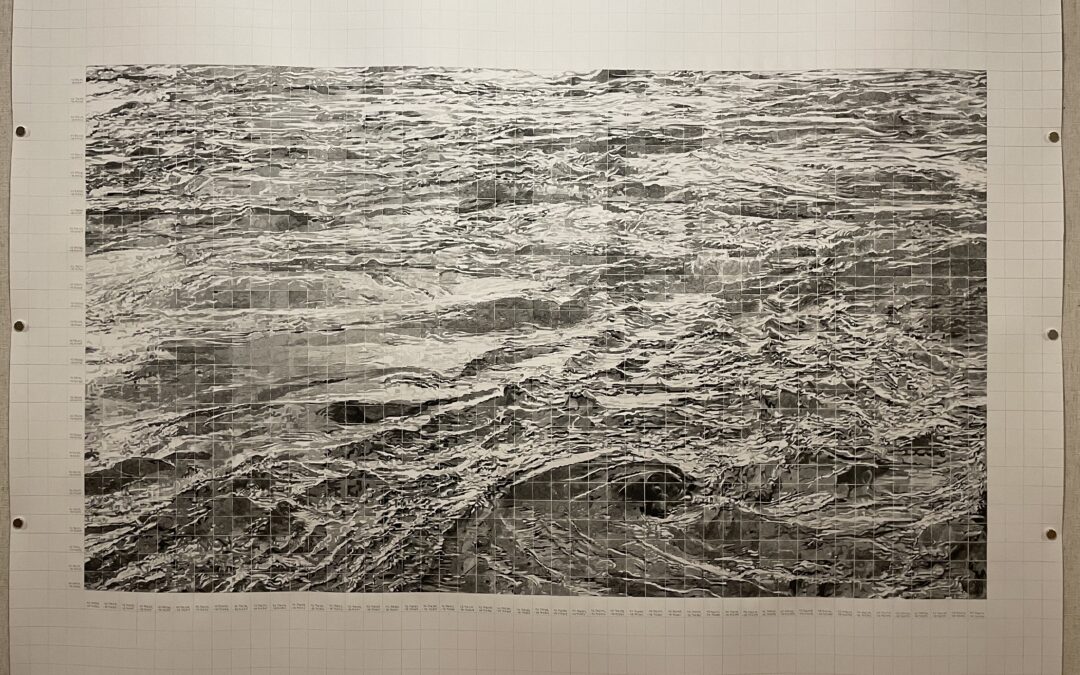
The drawings in Turbulence are done using a grid, where each square within the grid is drawn independently. The whole emerges from the parts, but the grid is still evident as a curiously rigid structure amongst the visual noise of the water. In each work, the grid appears to both order, and be eroded by, turbulence. Chen talks about the control working with a grid allows her, but also the abandon—visible in the slight incongruencies between details and tones from one square to the next. It’s a means to an end while also a process for incidental abstraction.
Chen also talks of the unruly nature of investigating turbulence itself. Despite being studied exhaustively through fluid dynamics, the machinations of turbulence remain relatively mysterious to those who study it. While some instances are tangible enough as to their origin (like the turbulence downriver of The Falls, or the construction of a major bridge), others arise curiously and without clear cause. The grids in Chen’s drawings show that while we can attempt a piecemeal order to turbulence, it will always insist—fractured and disruptive like the rapids and vortices of the Niagara River.
January M&T Fourth Friday photos available here. Photos by Nilson Rivera Photography.